r = 0.93
PSQI 65%
IEC 62471
1 + 2 / 5
01 THE PROBLEM
Circadian misalignment isn't a feeling.
It's measurable physiology, mistimed.
Roughly 700 million shift workers worldwide - 5 million in Korea alone - and 850 million people with chronic insomnia live on a schedule their internal clock never agreed to. Fatigue from a misaligned schedule
impairs cognitive and motor performance to a degree comparable with legally prohibited blood-alcohol levels¹,
and IARC - the WHO's cancer agency - classifies shift work involving circadian disruption as Group 2A, probably carcinogenic to humans.³
Precise assessment has traditionally required polysomnography or a specialised sleep clinic. The behavioural first line, CBT-I,
has required repeated in-person sessions with a trained sleep specialist. Both are scarce. So consumer wearables settle for
reporting sleep after the fact - measuring the outcome, never the cause, and intervening in nothing.
700M
shift workers worldwide, 5 million in Korea
850M
people living with chronic insomnia
Group 2A
IARC (WHO) classification of shift work involving circadian disruption³
0
consumer products that estimate circadian phase and act on that
estimate in a daily closed loop
02 THE PLATFORM · SF CHRONO-SYNC AI
One validated core.
Two ways of acting on it.
Both CES entries run on the same engine - not a shared brand, a shared codebase. SF Sleep Engine acts in software. SleepRhythm Light acts in hardware. One validation event grounds both,
and the loop closes every 24 hours.

STEP 1 · BASELINE
JAM-BTI
Smartphone lifelog (light, activity, screen time) classifies the user into one of 16 sleep phenotypes across four axes - sleep onset, sleep quality, sleep duration, daytime sleepiness. This sets the starting protocol.

STEP 2 · SENSE
SF-Engine
FJK (Forger–Jewett–Kronauer) differential equations solve for circadian phase (Process C) and sleep pressure (Process S) in real time. The two interact nonlinearly and cannot be separated by regression; solving both simultaneously as a differential-equation inverse problem, with no dedicated biosensor, is the non-obvious core.

STEP 3 · SCORE
CMI
The phase estimate condenses into the Chrono-Mismatch Index - a proprietary 0–100 score of the gap between the current and the desired rhythm, reaching r=0.93 agreement with salivary DLMO. One number a nurse or an HR manager can read without training.

Step 4 · Act
Adaptive Sleep Routine(ASR)
Software shifts tonight’s bedtime and wake time from yesterday’s measured sleep efficiency and selects from 30 relaxation exercises matched to the user’s type. Hardware converts the same estimate into a 480-500nm dose placed on the right side of the phase response curve. Execution data returns overnight; CMI recalculates; tomorrow’s plan changes.
Entry 1 · Software · B2C / B2B / B2H · USD 9.99 per month
SF Sleep Engine
First Closed-Loop AI Circadian Management Platform
A software-only AI platform that estimates circadian phase and manages misalignment from it - no biosensor, no sleep laboratory, no therapist in the loop. It will be delivered first through the SleepKeeper app for shift workers, then extended to our existing consumer app.


TECHNICAL PROBLEM
Assessment and behavioural guidance have always shipped as two disjointed products - wearables that monitor, therapists who treat. SF Sleep Engine connects circadian-phase estimation directly to an automated daily routine inside one architecture, using only standard lifelog data.

PERSONALISATION
Existing digital therapeutics deliver static content chosen once at onboarding.
SF Sleep Engine recalculates JAM-BTI and CMI daily,
so the protocol tracks a changing circadian condition without a therapist.

ENTERPRISE LAYER
A B2B dashboard aggregates de-identified, organisation-wide CMI distributions in real time and generates occupational safety reporting - a circadian-specific layer standard employee assistance programmes do not have.
01
Validating the rule, not the output
Conventional digital CBT-I ships a static, pre-set content sequence because that exact sequence was clinically validated; changing it would mean
re-validating every variation. SF Sleep Engine validates the adaptation rule itself - the CMI-driven decision algorithm. Because the algorithm is the validated unit, the routine it produces can legitimately evolve day by day with incoming data.
02
Cross-channel algorithmic scalability
Rather than building separate, independently validated products for consumer wellness, enterprise SaaS and a future clinical channel, one validated core deploys across all three tiers - so a single validation event advances the consumer app, the enterprise safety dashboard and the future clinical platform at once.
03
Inverted protocol for night shifts
Standard chronotherapy says: get bright light in the morning. For a night-shift worker that advances a clock that needs delaying. SleepKeeper will read the actual roster, invert the schedule - bright light during the shift, light blocked on the commute home - and deliberately delay the clock instead of fighting it. The same instruction drives SleepRhythm Light directly, which positions its 480-500nm boost late in the subjective day to push the phase shift in the same direction. Roster ingestion is automatic; the worker sets nothing.
04
End-to-end domain consolidation
The market isolates sleep assessment, therapist-led treatment and organisational risk monitoring into siloed vendors. SF Sleep Engine closes the loop from estimate to intervention autonomously - no clinician, therapist or safety analyst required at any stage.
Entry 2 · Hardware · IEC 62471 certified · USD 299
SleepRhythm Light
World's First AI Closed-Loop Circadian Lighting System
A three-channel LED luminaire - 2700K warm, 6500K cold, and an isolated 480-500nm channel aimed at ipRGCs, the eye’s non-visual circadian receptors - taking its timing from the same SF-Engine phase estimate, inside a pre-certified safety envelope.


Form language drawn from lighting, not medical hardware
- a device people leave out on the nightstand.
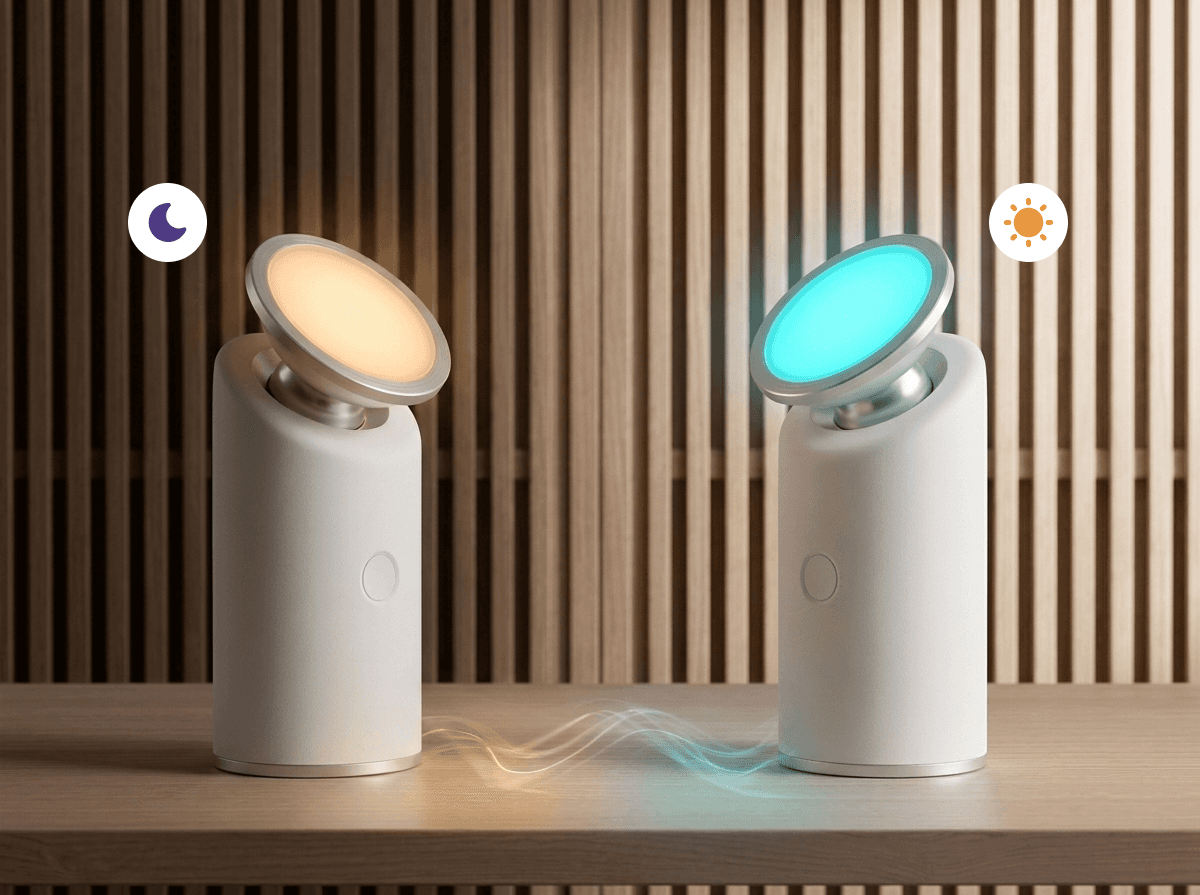
Sunrise · starts 30min
before calculated wake
Warm and cool rise together.
The 480-500nm channel stays dark until
the pair passes 70%, then fast-ramps - late enough that the melanopic pulse never lands as a startle-glare step, early enough to support the cortisol awakening response.
Daylight · 12–16h
Cool holds maximum while warm falls to
a 15% floor at subjective noon and climbs back to full before dusk, tracking a synthesised colour temperature arc from 3200K to 6500K and back. Built for night-shift and indoor-bound users with no access to real daylight.
Sunset · 120min
Three segments, not a fade. Cool drops to zero and warm co-dims to a 45% reading floor over 30minutes; that floor holds for 45 minutes - a reading window with zero short-wavelength content; then a logarithmic decay to darkness over the final 45.
3-channel LED - 480-500nm (ipRGC / melanopic) + 6500K cold + 2700K warm, independent PWM
3200K (dawn / dusk edge) – 6500K (solar peak), mired-linear channel mixing
Sunrise (30min before calculated wake) · Daylight 12–16h (personalised) · Sunset 120min
Daytime 480-500nm boost
up to 10,000lux (blue-enriched mode)
per-channel constant current - logic-level N-channel MOSFET on a boost-converted rail
iOS / Android companion app over BLE 5.0; smart-home integration targeted for LG ThinQ and Samsung SmartThings
01
Dynamic safety envelope certification
Conventional phototherapy devices are certified for a single static profile; altering output normally triggers re-certification, which is why competitors ship fixed-dose timers. Our diffuse-mode predecessor held IEC 62471 certification across its entire 200-step dynamic range, and the directional geometry extends the same principle - one envelope covering the full dimming range at the fixed 45cm and 18° geometry, with certification in progress. Certifying the envelope rather than each state is what lets SF-Engine vary spectral ratio and intensity daily, including the reading-floor curve.
02
One validated core, two modalities
Hardware and software are conventionally validated as disjointed products, leaving efficacy dependent on the user interpreting between them. SleepRhythm Light reuses the exact IRB-validated SF-Engine that powers the software assessment, so one validation event grounds both a behavioural and a light-delivery intervention. Execution data returns over BLE 5.0 to recalibrate the following day's regimen.
03
The same lamp advances or delays the clock, on purpose
Direction of phase shift is a function of when the melanopic dose lands, not how bright it is. SF-Engine positions the daytime 480-500nm pulse against the user’s own phase response curve: early in the subjective day to advance a delayed clock, late in the subjective day to delay the clock of someone about to work a night shift. Competing lamps expose brightness and a timer; the direction of the shift is left to the user to get right.
04
ipRGC isolation instead of brute-force lux
Static 10,000-lux white lamps buy melanopic effect with glare, and glare is what drives discontinuation. Isolating 480-500nm - peak ipRGC sensitivity, a melanopsin pathway distinct from the rods and cones that form vision — reaches the same circadian target at far lower photopic intensity, which is what makes a two-hour Sunset segment tolerable at all.
03 COMPARISON
What exists, and what doesn’t.
Trackers report after the fact. Lamps deliver fixed-dose light. Digital therapeutics deliver static content. SleepForest closes the loop from phase estimate to timed intervention and back.
*Category comparisons describe product classes, not named vendors, and reflect publicly documented capabilities at the time of writing.
04 Evidence, certification and IP
Everything on this page that carries
a number, and where it comes from.
Clinical validation
IRB-approved study at Kyung Hee University Hospital at Gangdong (N=45): the SF-Engine phase estimate reached r=0.93 agreement with salivary melatonin onset (DLMO), and participants following the routine reported a 65% improvement in Pittsburgh Sleep Quality Index global score.
A 28-day raw-data collection with a comparative DLMO protocol
(n=60, Bland–Altman / ICC, shift-worker correction) is in preparation. Results are not yet peer-reviewed.
Certification and recognition
•
IEC 62471 photobiological safety * tested by KCL(Korea Conformity Laboratories); certification for the final directional configuration in progress
•
Government-certified venture company, Innovation-Growth type (Korea)
•
TIPS - Tech Incubator Program for Startup, Korea's flagship startup
R&D programme
•
Corporate R&D institute recognised by KOITA
Patents
•
Granted - Adaptive-intervention lifestyle behaviour monitoring device and method (KR 10-2530246)
•
Filed 2025.08 - Terminal-based sleep pressure and circadian rhythm estimation (10-2025-0119046)
•
Filed 2025.08 - Sleep classification and personalised sleep management system (10-2025-0110518) · JAM-BTI and CMI · corresponding international applications in preparation
•
In preparation - Circadian-based smart phototherapy control algorithm and device
Trademarks
•
JAM-BTI - registered KR (2025.08)
•
JAM-BTI - international filing (2026.01), US and EU
•
Kkuljam Doctor - registered KR (2025.02)
•
Five marks registered in total
Regulatory status. Neither product is currently cleared or approved as a medical device in any jurisdiction. Both ship as general wellness products and neither diagnoses nor treats any condition. Clinical figures on this page come from investigational studies and are presented as evidence of algorithm performance, not as claims of therapeutic benefit. Regulatory pathway: MFDS (Korea) SaMD filing and clearance targeted 2027; U.S. FDA De Novo and EU CE MDR targeted 2029.
05 The groundwork
A user base and a phenotype vocabulary,
already in consumers' hands.
JAM-BTI has reached consumers through a live wellness app since 2025, which is where the phenotype vocabulary,
the audience and the real-world sleep records come from. The two CES entries are what that groundwork becomes once circadian phase estimation, the closed loop and the light are added - none of which is in a released product today.

Kkuljam Doctor
Live · beta
Consumer app on the App Store and Google Play. Presents JAM-BTI as a phenotype read with routine guidance, plus sleep reports and pre-bed routines. It does not estimate circadian phase, does not compute the CMI, does not run a closed loop and does not drive any hardware.
SleepKeeper
In development
The shift-work build, developed under a TIPS national R&D grant, and the app through which SF Sleep Engine will first be implemented in full - reading the roster, setting when to seek light, when to block it and when to sleep, and driving SleepRhythm Light. Not yet released.
Rollout to
Kkuljam Doctor
Planned
Real-time CMI computation, the daily closed loop and hardware actuation are scheduled to reach Kkuljam Doctor after SleepKeeper, bringing the existing wellness audience onto the same validated core.
120,000+
subscribers to the founder's sleep-medicine YouTube channel - a physician-led acquisition channel
KRW 1.23 bn + 1.1 bn
cumulative private investment plus government R&D funding, at a KRW 8 bn valuation
10
full-time staff across clinical, algorithm, engineering and commercial tracks
2025
year the JAM-BTI phenotype label first reached consumers
What is new, stated precisely. Circadian phase estimation, the Chrono-Mismatch Index, the daily closed loop and light actuation are not implemented in any product available to the public today. Kkuljam Doctor uses JAM-BTI as an informational phenotype label only. SF Sleep Engine and SleepRhythm Light are new products, first released 1 March 2027.
06 Ecosystem
Validated by the companies that would have to integrate it.
Joint development · PoC
LG Electronics
Smart bed programme: sleep function and intelligent lighting integration, under LG's Deep Tech Value-Up initiative. Seven-month PoC from August 2026.

MOU · API licence
Asleep
Contactless breath-sound sleep staging to be integrated into our apps under a signed API agreement. Joint presence in the Samsung smart-bedroom exhibit at CES 2027.

Letter of intent
Kakao Healthcare
Integration with the PASTA platform to extend sleep services across Kakao's health data footprint.

Deployment pilot
Lotte Hotel senior residences
Sleep improvement programme for senior-living residents - the entry point for the older-adult and chronic-comorbidity track.

Clinical and academic network
Clinical network
Kyung Hee University Hospital at Gangdong · Kyung Hee Institute of Medical Science · Bobath Memorial Hospital · Seoul Northern Municipal Hospital
Joint clinical work on algorithm validation, DLMO comparison, neurological comorbidity and public sleep programmes.

Academic advisory
Kyung Hee University
Prof. Jeong Jae-yoon (Industrial Engineering, algorithms) · Prof. Lee Seung-ryong (Computer Science) · Prof. Kim Young-sun (Graduate School of East-West Medicine, gerontology).

07 Roadmap
From consumer testbed to prescribable therapeutic.
Consumer and enterprise deployment accrues the real-world evidence; that evidence carries the same core into the regulated channel. One engine, three tiers, one validation lineage.
2022 - 2025
Foundation
Company founded, TIPS selected, venture certified, SF-Engine / CMI / JAM-BTI built and filed, Kkuljam Doctor launched.
2026 - 2027
Closing the loop ·
CES 2027
SleepKeeper for shift workers,
LG smart bed PoC, and commercial launch of SF Sleep Engine + SleepRhythm Light on 1 March 2027.
2028
Regulated channel
Insomnia CBT-I clinical study completion, chronic-disease and older-adult expansion, following MFDS SaMD clearance targeted 2027.
2029+
Global
Prescribable pathway, FDA De Novo and CE MDR targets, North America and Asia expansion.
08 Team
Built by the clinician, not around him.

Shin Won-chul, MD, PhD
Clinician-Founder and CEO, SleepForest
•
Professor of Neurology, Kyung Hee University Hospital at Gangdong
•
•
Vice Dean, Institute of Medical Science and Civilization, Kyung Hee University Medical Center
•
•
Drug Committee, Korean Epilepsy Society
•
CORE TEAM
09 CES 2027
Come and stand in front of it.
The Sunset curve above is the one thing that does not read on a slide. We run it live at both stands - bring a book, sit at the reading-floor level, and see whether you would actually leave it on.
Eureka Park
Seoul Pavilion (SBA)
Both CES 2027 Innovation Award entries on the stand - SF Sleep Engine running live on device, and SleepRhythm Light executing the full Sunrise / Daylight / Sunset profile.
Venetian Expo · Booth TBC
2026 - 2027
Samsung smart bedroom
SleepRhythm Light integrated into the smart-bedroom environment alongside Asleep's contactless sleep sensing, showing the closed loop running against a third-party measurement source.
Central Hall · Booth TBC